- Rodent only specialists
Mouse Removal in Chino Hills
Droppings in the pantry, scratching behind the stove? We find where the mice get in, trap the ones inside, and close the gaps. No poison in your kitchen.
- Licensed, bonded and insured
- Based in Chino Hills
- Sealed out, not poisoned
- Open 7am to 11pm
Mouse removal in Chino Hills is mostly a cold weather job. Once the nights turn cold, usually from late October through February, mice move indoors. Someone opens a pantry drawer and finds small dark droppings on the shelf liner, or hears faint scratching in the wall behind the dishwasher after the kitchen goes quiet.
House mice are a different animal from rats. They live within a few yards of their food, slip through gaps most people never notice, and breed fast enough that a pair in November is a family of thirty by spring. So we do not start with traps. We start by finding the opening.
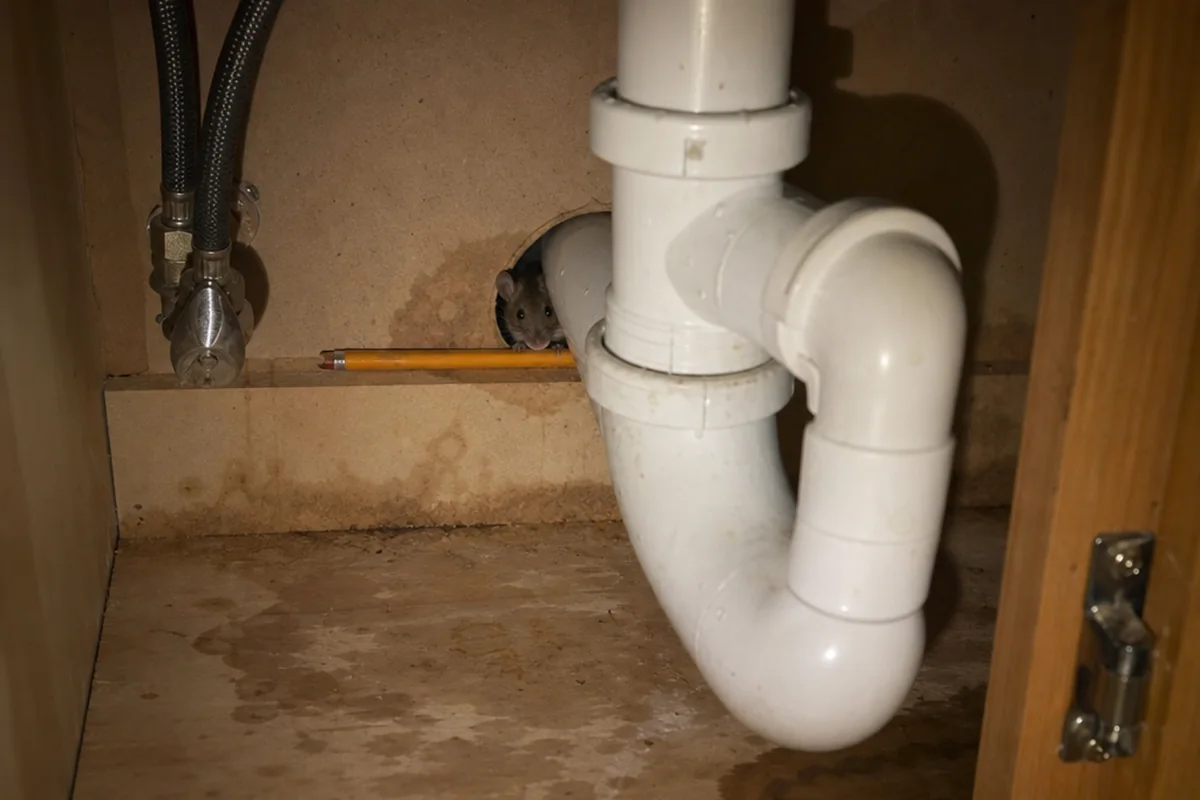
Mouse or rat? Check before you call
A fair share of what looks like a mouse problem turns out to be roof rats. The treatment changes with the species, so here is how to tell them apart.
| Feature | House mouse | Roof rat |
|---|---|---|
| Size | Two to four inches plus tail | Six to eight inches, tail longer than the body |
| Droppings | Dark grains of rice, many at once | About half an inch, fewer of them |
| Sound | Light and quick, often inside kitchen walls | Heavy enough to follow across the ceiling |
| Where signs show | Kitchen, pantry, garage, under sinks | Attic, rafters, roofline |
| Gap needed | A quarter inch, the width of a pencil | About the size of a quarter |
Half inch droppings and noise overhead at night mean rats, and our rat removal page is the one to read. Tiny droppings and activity at floor level in the kitchen or garage mean mice. Keep reading.
Signs of mice in your home
- Droppings along the edges. Mice run the perimeter of a room, so look along baseboards, the back of drawers, under the sink and on top of the water heater.
- Gnawed packaging. A corner chewed off a cereal box, a small hole low on a bag of rice, birdseed or dog food scattered in the garage.
- Shredded nesting. Paper towel, insulation or dryer lint pulled into a soft ball in a drawer, behind the fridge or inside a stored box.
- Light scratching in the walls. Usually low down and near the kitchen, never the heavy footfalls people hear from rats.
- A musky smell in a closed cabinet. Mouse urine has a stale, sweet edge that builds in enclosed spaces.
- Dark smudges at floor level. Rub marks where their coats touch the same corner every night, often right at the gap they are using.
Mice do not mean your house is dirty. A spotless kitchen with an open gap under the dishwasher gets mice, and a cluttered garage with a sealed perimeter does not.
Free mouse inspection
We find the openings and give you a written plan. No cost, no obligation.
Related services
Fresh droppings again this morning?
Book a free mouse inspection and find out where they are coming in before one nest becomes three.
How we stop mice at the source
With mice the inspection happens low and close. We are on our knees in the kitchen with a flashlight before we ever look at the roofline, because that is where the openings are.
- 1. Find the openings. We pull the kick plate off the dishwasher, check where gas and drain lines pass through cabinet backs, run a hand along the garage door seal, and check the weep screed at the base of the stucco. Every gap goes into your written findings.
- 2. Trap along the runways. Snap traps in covered, tamper resistant housings, set every few feet along the walls the mice already use. We keep checking until the sets stay empty.
- 3. Seal every gap. Copper mesh packed into the opening and locked in with sealant, hardware cloth over vents, a new rubber seal where the garage door seal has curled. Steel wool alone is not enough. It rusts, shrinks, and mice pull it out.
- 4. Clean the trail. Droppings and nesting come out of cabinets and drawers, surfaces are sanitized, and the urine scent that tells the next mouse where to go is treated.
- 5. Verify. We check the traps and the seals before we call it finished.
The sealing step is the whole point. A trap catches the mouse that is inside today. Sealing decides whether there is one inside next winter. The detail of that work lives on our rodent proofing page.
Why poison fails with mice
Mice are nibblers. A house mouse eats twenty or more tiny meals a day from as many spots, so a bait block is one snack among many and often never adds up to a lethal dose.
- They breed faster than bait thins them. A female can have five or six pups every three to four weeks, and the pups breed at six weeks old.
- They die in the kitchen wall. A few feet from the pantry, inside a cabinet back or a wall void, so the smell sits exactly where you cook.
- It puts rodenticide where kids and pets live. Mouse territory is your kitchen floor and your garage.
- The gap is still open. Bait does nothing to the quarter inch opening under the sink, and the next mouse from the slope walks straight in.
What mouse removal costs in Chino Hills
We do not quote mouse work over the phone. A pantry with two droppings and a garage with a nest in every stored box are not the same job. What sets the price is how many openings we find and how much cleanup the mice have left behind. The inspection is free, you keep the written findings either way, and the quote you get is in writing before any work starts.
Safety for your kids and pets
We do not use poison or bait anywhere in your home. Traps sit inside covered housings a toddler or a dog cannot get into, behind appliances and inside cabinets rather than out on the floor. Droppings are never swept dry, because the dust is the health risk. They are wetted, wiped and bagged, and cabinets are sanitized before the shelf liner goes back.
Where we look for mice
The low, hidden spots mice actually use.
- Under sinks and behind appliances
- Gas, water and drain penetrations
- Garage door seals and corners
- Weep screed and stucco base
- Water heater closets and laundry rooms
- Warranty
Every sealing job comes with a warranty
Every home we rodent proof and seal gets a warranty on that work. Ask us for the terms at your free inspection.
Mouse removal FAQ
How can I tell if it is a mouse or a rat?
Mouse droppings look like dark grains of rice and turn up in the kitchen, pantry and garage. Rat droppings are about half an inch and usually turn up in the attic, with heavier noise overhead at night. If you think it is rats, our rat removal page covers that work. If you are not sure, the free inspection settles it.
How are mice getting in through such small gaps?
A house mouse can flatten itself through any opening its skull fits, about a quarter inch. That is the gap around a drain pipe through a cabinet back, the curled corner of a garage door seal, or a crack in the weep screed at the base of the stucco. Almost every home has a few.
Do mice mean my house is dirty?
No. Mice come inside for warmth when the nights cool, and a clean home with an open gap gets them as readily as a messy one. Food only decides where they nest once they are in.
Are the traps from the hardware store enough?
They can catch a mouse. If droppings keep appearing after the traps have worked, the problem is the opening, not the trap. Sealing is what ends it.
How do you keep mice out long term?
By closing every opening with copper mesh and sealant, screening vents with hardware cloth, and replacing worn garage door seals. For homes on the open space edge we also offer the D.A.R.T. maintenance program, Drive Away Rodent Traffic, so the seal gets checked rather than assumed.
Will you put down poison if I ask?
No. We solve mouse problems by sealing them out, not by scattering poison through a kitchen. If you want a bait only service we are probably not the right fit.
Do you also treat ants or other insects?
No. We only handle rats, mice and the damage they leave behind. We do not treat insects, termites, bed bugs, cockroaches or mosquitoes. For those, a general pest control company is the right call.
Services that finish the job
Trapping clears the mice that are inside. These are the steps that keep the next ones out.
Rodent Proofing
The permanent step. Every gap packed, sealed and screened with materials mice cannot chew through.
Rodent Inspection
Not certain what you are dealing with? Start here and get the findings in writing.
Rat Removal
Heavier noise overhead and larger droppings in the attic point to rats, which is a different job.
Where we handle mouse removal
We dispatch from our Chino Hills office and cover 19 cities. This page is part of our wider rodent control in Chino Hills service.
Get the mice out and keep them out
A real person answers from 7am to 11pm every day, in English or Spanish. After 11pm leave a message and we will call you back in the morning.