- Rodent only specialists
Rodent Proofing and Exclusion in Chino Hills
Rodent proofing is the step that ends the problem. We find every gap a rat or mouse can use, close it with steel they cannot chew, and check the work before we call it done. No poison, no monthly bait route.
- Licensed, bonded and insured
- Based in Chino Hills
- Steel mesh, not foam
- Open 7am to 11pm
What rodent proofing actually means
Rodent proofing, also called rodent exclusion, is closing every opening in a building that a rat or mouse could use to get inside, with materials they cannot chew through. Trapping deals with the animals already in. Proofing deals with the ones that have not arrived yet. It is the part of rodent control that changes the outcome, and the part that is easiest to skip because it is slow work on rooflines and in crawl spaces.
A mouse needs a gap the width of a pencil. A roof rat needs a hole the size of a quarter, and if the edge is wood or stucco it will gnaw a smaller one until it fits. So the job is not finding the big hole. It is finding all thirty small ones and knowing which four are in use. We are Green Rodent Chino Hills, part of the Green Rodent Restoration brand, and every rat removal and attic cleanup we run ends with this step.
Signs your home needs rodent proofing
Some homes need proofing because rodents are inside now. Others because the last company trapped them and left the door open.
- The problem keeps coming back. Rats trapped last year, noise back this fall. That is an unsealed entry being found again by the next generation.
- A bait station contract with no end date. If someone refills boxes every month, the building has never been closed.
- Daylight in the attic. With the lights off, any glow at the eaves, a vent, or where roof meets wall is a hole that matters.
- Curled garage door seals. The bottom seal curls at each end with wear. That curl is one of the first places we check on a tract home garage.
- Grease and chew marks at one spot. Rodents use the same doorway every night. A dark smear on stucco below the eave or fresh gnawing on a fascia board is a live entry.
Not sure whether you have rodents right now? Proofing with animals still inside seals them in the walls. Start with a rodent inspection and we will tell you whether trapping comes first.
Free exclusion estimate
We map every entry point and give you a written plan. No cost, no obligation.
We call from (909) 281 7828 during open hours.
Related services
Tired of sealing the same problem twice?
Get every entry point on your home mapped in writing before anyone quotes you a number.
Our exclusion process
Exclusion in the wrong order fails. Seal first and you trap animals inside. Seal without a follow up and you never learn which gap you missed.
- 1. Full perimeter and attic inspection. Roofline, eaves, every vent and penetration, the garage door, the foundation line, and the crawl space. Each opening is photographed and marked in the written estimate.
- 2. Clear the building if it is occupied. Trapping runs first. A one way valve on the main doorway lets rodents inside leave and nothing return. The last gap is sealed once the traps go quiet.
- 3. Seal each opening with the right material. Hardware cloth on vents, sheet metal on chewed fascia, copper mesh in pipe gaps, mortar at the foundation, closed bird stops on tile eaves. Foam and caulk are only a binder behind metal, never the barrier.
- 4. Reduce what draws them in. The branch touching the roof, the fruit under the tree, the open bag of pet food.
- 5. Verify. Monitoring traps stay in the attic and are checked before the job is closed. No activity and no chew marks at the seals means the building is closed.
Ready for the lasting fix? Request a free exclusion estimate and we will map your home before you commit to anything.
Where rodents get into Chino Hills homes
Many homes here are stucco over wood frame with a concrete tile roof and an attached garage, and that style has predictable weak points.
| Entry point | Who uses it | How we close it |
|---|---|---|
| Tile roof eaves and bird stops | Roof rats | Metal or mortar eave closures |
| Gable and attic vents | Rats and mice | Quarter inch galvanized hardware cloth |
| Pipe, conduit and AC line penetrations | Mice, then rats | Copper mesh packed tight, then sealed over |
| Garage door corners and bottom seal | Mice | New bottom seal plus metal corner guards |
| Foundation vents and crawl space hatch | Norway rats | Screened vent covers and a fitted hatch |
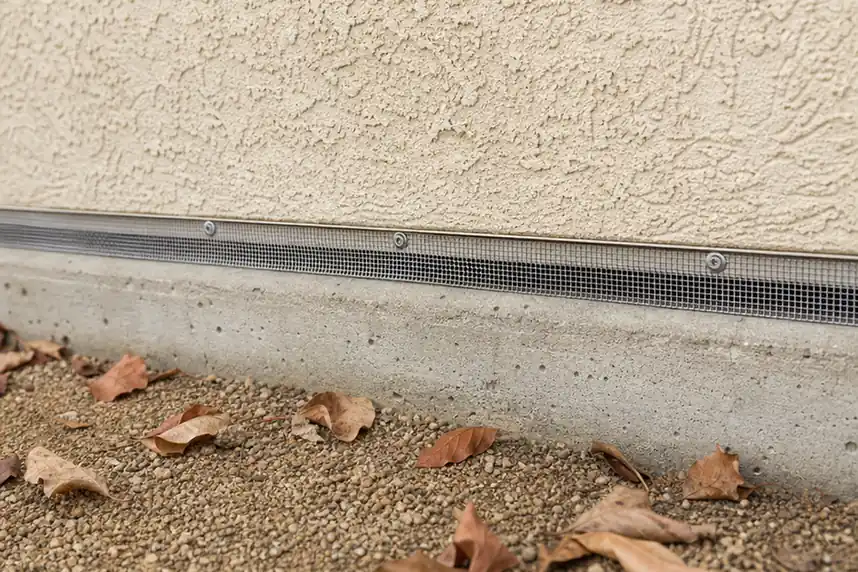
| Stucco weep screed | Mice | Stainless screen that still drains |
| Dryer and bathroom exhaust vents | Rats and mice | Louvered guard that opens with airflow |
Why exclusion beats poison long term
Poison answers how to kill the rodents here today. Exclusion answers how to stop having rodents.
- Poison leaves the door open. Bait empties a territory and leaves a scent trail to an open gap. The next rats find the same gap, which is why bait programs never end.
- Exclusion is a finish line. A sealed building does not need a visit next month. The steel is still there next year.
- Nothing dies in your walls. A poisoned rat crawls back to a nest inside a wall cavity or a duct. With trapping and sealing, the building is empty when it closes.
- Pets and wildlife stay out of it. No rodenticide means no secondary poisoning risk for dogs, cats, owls, or hawks.
For canyon edge homes where the pressure never lets up, we pair exclusion with D.A.R.T., Drive Away Rodent Traffic, so the seals and monitors get checked on a schedule. That is a check on finished work, not a bait subscription. See D.A.R.T. maintenance.
What rodent proofing costs in Chino Hills
We do not quote exclusion over the phone because the price is the count. A single story home with one roofline and six openings is a different job from a split level on a slope with three rooflines, a crawl space, and twenty. The inspection is free, the entry point map is yours either way, and you get the written estimate before you decide anything.
Safety and materials
Everything we install is inert once in place: galvanized and stainless hardware cloth, copper mesh, sheet metal, mortar, and exterior grade sealant. No pesticides, nothing that attracts pets or children. Vent covers and weep screens are chosen so the house keeps breathing, because an attic that cannot ventilate is a moisture problem. We never close an airflow opening. We screen it.
What the exclusion estimate covers
One visit, and you keep the findings either way.
- Roofline, eaves, and every vent
- Garage, foundation, and crawl space
- Every opening photographed and marked
- A written estimate, no phone guessing
- Warranty
Every sealing job comes with a warranty
Every home we rodent proof and seal gets a warranty on that work. Ask us for the terms at your free inspection.
Rodent proofing FAQ
What is rodent proofing?
Rodent proofing, or rodent exclusion, is sealing every opening in a building that rats or mice could use to get inside, with materials they cannot chew through. Trapping removes the animals already inside. Proofing stops the next ones following them in.
What gaps do rodents actually use?
A mouse fits through a gap the width of a pencil and a rat through a hole the size of a quarter. On Chino Hills homes the usual ones are open bird stops under tile eaves, unscreened vents, curled garage door seals, pipe penetrations, and the weep screed.
What materials last?
Metal and masonry. Galvanized or stainless hardware cloth with quarter inch openings, copper mesh, sheet metal, and mortar. Expanding foam, caulk, plastic screen, and wood filler all get chewed through and only work as filler behind metal.
Does exclusion work without trapping first?
Only on a building that is currently empty. If rodents live inside, sealing every gap traps them in the walls, where they chew new exits or die in the cavity. We inspect first, trap or fit a one way valve if there is activity, and close the last opening once the traps go quiet.
How long does rodent proofing hold?
Metal and mortar do not get chewed through. What changes is the house. A new roof, a new AC line, or a tree growing back into the eaves can open a fresh route. Every seal is listed in your paperwork so you know where to look, and D.A.R.T. checks them on a schedule.
Is it worth it compared to a monthly poison service?
Exclusion costs more on the day and less over the years, because it ends. A bait route is billed every month for as long as you keep it, and the building stays open the whole time. Nothing dies inside your walls either.
The steps around exclusion
Three of these come before proofing. The fourth keeps the building closed after it.
Rodent Inspection
The first step. What you have, where it gets in, and whether trapping comes first.
Rat Removal
Active rats are trapped and removed before the building is sealed.
Mouse Removal
Mice use smaller gaps. Removal first, then the pencil width seals.
D.A.R.T. Maintenance
Drive Away Rodent Traffic. Scheduled checks of seals and monitors for homes on the canyon edge.
Where we handle rodent proofing
We dispatch from our office at 14738 Pipeline Ave #555, Chino Hills, CA 91709 and cover 19 cities. This page is part of our wider rodent control in Chino Hills service.
Close the building to rodents
A real person answers 7am to 11pm every day, in English or Spanish. After 11pm leave a message and we call back in the morning.